

Bayreuth Festival: Tickets, the Green Hill, and Wagner's Complicated Legacy
Last updated July 2026, this guide explains what the Bayreuth Festival actually demands of visitors, not just when it happens. Richard Wagner's festival runs on a fixed calendar every year, from 25 July to 28 August, at the Bayreuth Festspielhaus on the Green Hill. Securing a seat is its own project, and so is surviving the wooden benches once you're inside.
What Is the Bayreuth Festival?
The Bayreuth Festival is an annual event dedicated only to the stage works of Richard Wagner, staged at a theater he designed for that single purpose. Wagner called his vision a Gesamtkunstwerk, a total work of art that fuses music, drama, and stage design into one experience. He opened the Festspielhaus in 1876 with the premiere of Der Ring des Nibelungen, and composers Tchaikovsky, Grieg, and Bruckner reportedly sat in the audience. Only a handful of his ten mature operas are staged each season, which is why Wagnerians describe a trip here as a pilgrimage rather than a night at the opera. Wagner first considered Munich, then Nuremberg, before settling on Bayreuth in the early 1870s. Chancellor Otto von Bismarck twice declined to fund the project, so Wagner turned to public fundraising instead. That push created the first Wagner Societies, a model that still shapes how the festival distributes tickets today. In a 2026 anniversary message posted on the festival's official site, German President Frank-Walter Steinmeier described it as unlike any other opera festival in the world, tied to one work, one artist, and one place. Bayreuth's fixed 25 July to 28 August run places it firmly on Germany's summer festival calendar every year.
Inside the Festspielhaus: Sound, Seats, and the Green Hill Experience
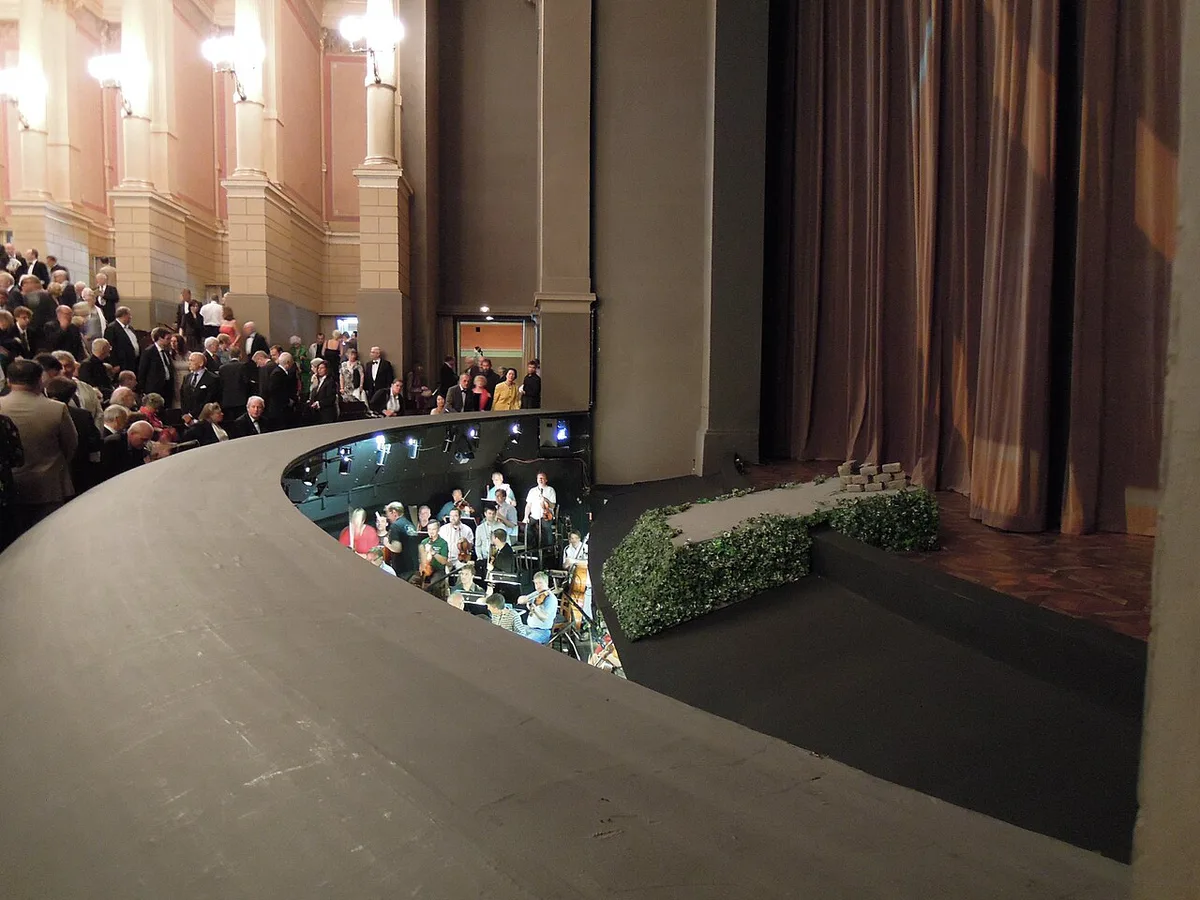
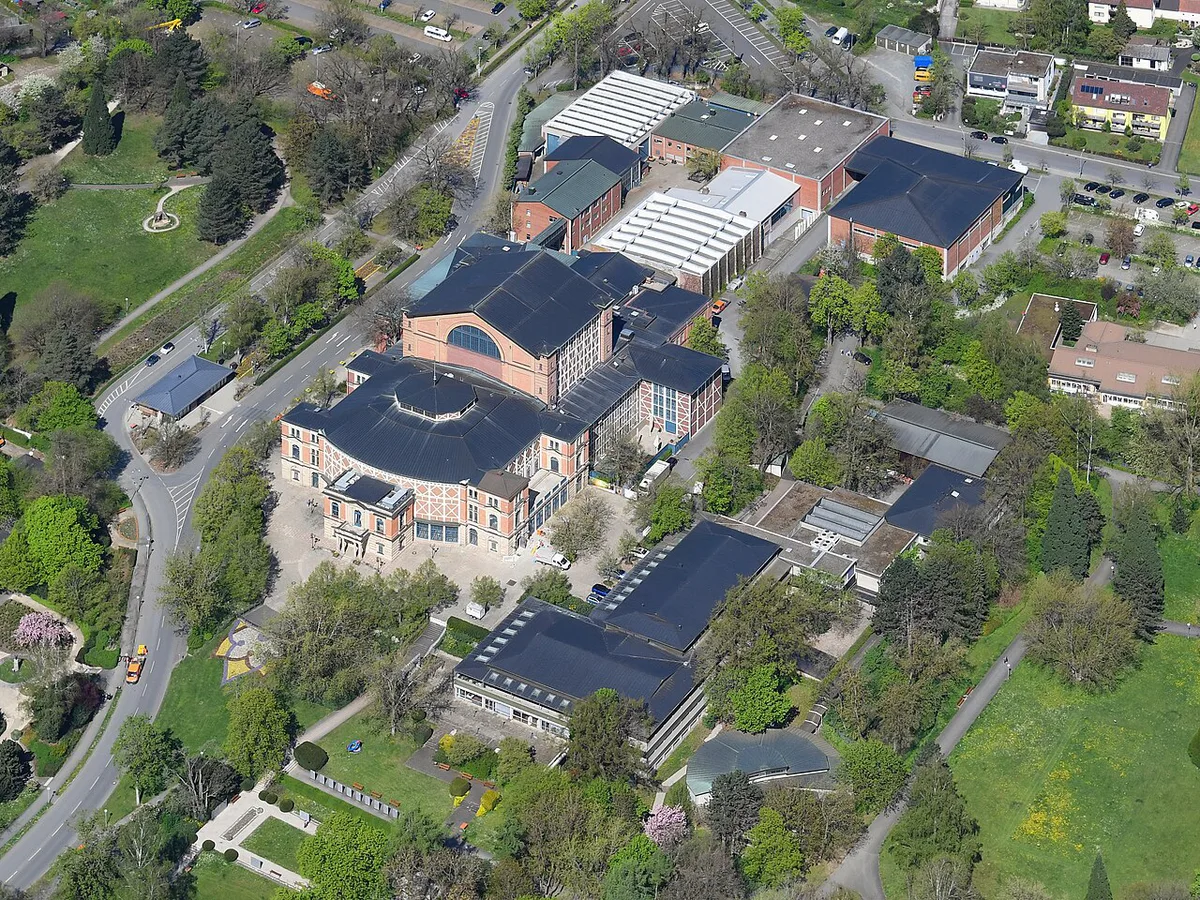
Richard Wagner rejected architect Gottfried Semper's first designs and hired Leipzig architect Otto Brückwald to finish the job. Construction began in 1872, and King Ludwig II of Bavaria covered the final costs with a credit of 400,000 Marks. Wagner's real innovation sits below the stage, in an orchestra pit up to 12 meters deep that hides the musicians entirely. Bayreuth Tourismus describes this hidden pit as a game changer, since it sends the orchestra's sound indirectly into the hall so singers can project without competing against it. The 1,937-seat hall keeps every seat in a direct sightline to the stage. Placido Domingo reportedly called it the best opera house anywhere, according to Bayreuth Tourismus. Visitors can only see the Festspielhaus interior, including the auditorium, orchestra pit, and Königsbau, on a guided tour outside the festival season. Guided tours are unavailable while performances are running, so plan any interior visit for a different time of year. The official festival site also runs a performance database covering casts and productions back to 1951, plus a 3D tour of the theater for anyone planning ahead. The Festspielhaus sits on the Grüner Hügel, the Green Hill, above the town center in Upper Franconia, Bavaria. Check Bayreuth Tourismus or the festival's own site for current shuttle and parking details before a performance. Travelers who want a big outdoor German summer event without a ticket lottery might prefer the Rhine in Flames fireworks series. Towns along the Rhine host it on separate Saturdays between May and September. None of the Festspielhaus's engineering solves comfort, though. Expect these conditions on a typical night:
- Hard wooden benches with no cushions, and limited legroom throughout the hall
- No air conditioning, even during the festival's July and August heat
- Long intermissions built into the schedule, since a single Ring opera can run four to five hours
- A full Ring cycle spread across roughly 16 hours over several nights, matching the runtime of its 1876 premiere
How Bayreuth Festival Tickets Actually Work
Bayreuth ticket demand far outstrips supply. Roughly 2,000 spectators fit into each performance, and prices are widely reported as high, so several parallel booking paths exist instead of one simple box office. None of the sources here publish a standard price list, so confirm current ticket prices directly with the official ticket shop before booking flights or hotels. For general visitor questions and the city's own ticket shop, Bayreuth Tourismus publishes these contacts:
More than 200 young singers, instrumentalists, and stage professionals aged 18 to 35 attend annually through the Bayreuth Stipendium. However, the 2026 season stages Rienzi, reportedly Hitler's favorite opera, a choice that critics questioned in light of the festival's complex Nazi-era legacy.
| Office | Hours | Phone |
|---|---|---|
| Bayreuth Tourist Information | Mon-Fri 09:00-18:00, Sat 09:00-16:00, Sun/holidays (May-Oct) 10:00-14:00 | +49 0921 88588 |
| Festival Ticket Shop | Mon-Fri 10:00-17:00, Sat 10:00-14:00 | +49 0921 69001 |
- Online instant purchase: the festival opens a public sales window, typically in April, for seats left after the main allocation rounds
- Wagner Society route: chapters such as the Wagner Society of New York take member requests each autumn, prioritize members who missed out recently, and add a contribution equal to 15 percent of the ticket price
- The Bayreuth Stipendium: the Richard Wagner Scholarship Foundation sends more than 200 young singers, instrumentalists, and stage professionals aged 18 to 35 to the festival every year
The 150th Anniversary Season and What Comes Next
The Bayreuth Festival marks 150 years since its 1876 founding, and 2026 is the anniversary season. Beethoven's Ninth Symphony opens the 2026 program on 25 July. The centerpiece is a new production of Rienzi, staged, according to the Wagner Society of New York, only for 2026 and never again afterward. This season's lineup also continues a shift toward female conductors on the Green Hill. Nathalie Stutzmann conducts the new Rienzi, and Oksana Lyniv conducts Der fliegende Holländer. That trend builds on 2024, when Simone Young became the first woman to conduct a full Ring cycle at Bayreuth. Details for the 2027 season are expected in autumn 2026, per the Wagner Society of New York, so treat any 2027 listings published before then as provisional.
In 2024, when Simone Young became the first woman to conduct a full Ring cycle at Bayreuth, the festival advanced a shift toward female leadership. This reflects a broader transformation begun earlier, when Katharina Wagner, the artistic director and Richard Wagner's great-granddaughter, pushed the festival to confront its Nazi-era legacy.
- Rienzi: new production, conducted by Nathalie Stutzmann, staged for the 2026 season only per the Wagner Society of New York
- Der Ring des Nibelungen: conducted by Christian Thielemann across all four operas
- Parsifal: conducted by Pablo Heras-Casado, directed by Jay Scheib
- Der fliegende Holländer: conducted by Oksana Lyniv, in Dmitri Tcherniakov's production
Confronting the Green Hill's Nazi-Era Legacy
Richard Wagner was not only an opera composer. He was also an outspoken antisemite. In 1850, he published the essay Judaism in Music, arguing that Jews lacked an authentic artistic identity of their own. Adolf Hitler later became Wagner's most notorious admirer. Rienzi was reportedly Hitler's favorite opera. The Nazi regime used Wagner's music in propaganda films. According to DW, the regime also used it as part of the psychological torment inflicted in concentration camps during the Holocaust. After World War II, Winifred Wagner and her son Wieland underwent the Allied denazification process. Winifred then ceded her rights to sons Wieland and Wolfgang. The brothers distanced the festival from its past with sparse, minimalist productions known as the New Bayreuth style. Katharina Wagner, Richard Wagner's great-granddaughter and the festival's current artistic director, has pushed that confrontation further in recent decades. In 2017, she invited director Barrie Kosky to stage Die Meistersinger von Nürnberg. Kosky's production treated the character Beckmesser as a stereotyped, scapegoated Jewish figure. The 150th anniversary season revived this tension directly. Organizers disinvited Jewish public intellectual Michel Friedman from a memorial ceremony for victims of National Socialism, then reinstated him after public backlash. German newspaper Süddeutsche Zeitung called the episode a chronic German desire to avoid confronting the country's own history. Anno Mungen, director of the Research Institute for Music Theater Studies at the University of Bayreuth, went further in an interview with Die Zeit. He called festival leadership historically oblivious for staging Rienzi at Bayreuth for the first time in this anniversary year, given that it was Hitler's favorite opera.
Beyond the Opera House: Bayreuth Between Performances
Bayreuth offers more than the Festspielhaus, especially during the long gaps between performances in a Ring cycle week. The Margravial Opera House, a UNESCO World Heritage site built for Margrave Frederick in 1747, predates Wagner's own theater by well over a century. Wagner scouted this venue first, drawn to its large stage, before deciding it was too ornate and small for his own works. A self-guided Walk of Wagner route links sites connected to the composer's life, including the grave of his father-in-law, Franz Liszt, in the town cemetery. Haus Wahnfried, the Wagner family's former villa, now houses the Richard Wagner Museum and was also where Hitler visited Winifred and Siegfried Wagner during his frequent stays in Bayreuth. Wagner Society chapters have organized brewery tours and tastings at Maisel Bros. Brewery as a lower-key alternative to a formal post-performance dinner. In recent years, the festival orchestra has also performed free open-air concerts in front of the Festspielhaus. Check the official program for the current season to confirm whether that tradition continues.
Mistakes First-Time Bayreuth Festival Visitors Make
A few avoidable errors show up again and again among first-time Bayreuth visitors. Avoid these before finalizing a trip:
- Booking flights or hotels before tickets are confirmed, when the online instant purchase, Society, and Stipendium routes each run on their own separate timeline
- Underestimating opera length: the original 1876 Ring cycle premiere ran roughly 16 hours across multiple nights, and individual operas still run several hours with long intervals
- Assuming summer-casual dress works everywhere: formal or black-tie dress is traditional on the Green Hill, though norms are loosening for some performances, so check expectations for the specific night
- Skipping physical prep: no cushions, limited legroom, and no air conditioning make the hard wooden seats a real endurance test in July and August heat
How to Reach the Festspielhaus on Performance Day
The Festspielhaus stands north of central Bayreuth on the Grüner Hügel, separate from the main historic sights. Bayreuth Hauptbahnhof is the most practical arrival point for visitors without a car.
The uphill walk from the station usually takes about 20 minutes. Allow extra time for formal clothing, warm weather, and crowds near the entrance. A taxi is useful for visitors with limited mobility, but demand rises before performances.
- Regional trains connect Bayreuth with Nuremberg, the nearest major transport hub.
- Check Deutsche Bahn schedules carefully because Bayreuth services may require a regional connection.
- Confirm festival shuttle routes and temporary traffic restrictions through the official festival or Bayreuth tourism websites.
- Drivers should reserve parking time and follow event signage rather than relying only on navigation apps.
Arrive well before the announced start. Late seating can be highly restricted during an opera, and reaching the hall after the doors close may mean missing a substantial section.
For trip-planning details, see Bayreuth Festival (official) and Official regional tourism.
For the wider planning view, compare dates and recurrence rules in Germany’s festival calendar.
Explore more Bayreuth guides
Frequently Asked Questions
When is the Bayreuth Festival held each year?
The festival runs on a fixed calendar every year, from 25 July to 28 August. That makes it more predictable than many festivals that only announce dates a year or so ahead.
How do you get tickets to the Bayreuth Festival?
Three main paths exist. The festival's own online instant purchase window usually opens in April. Wagner Society chapters run an annual member request round each autumn and add a contribution equal to 15 percent of the ticket price. The Bayreuth Stipendium also sends young professionals aged 18 to 35 to the festival. Confirm current prices and windows with the official ticket shop before booking travel.
What should you wear to the Bayreuth Festival?
Formal or black-tie dress is traditional on the Green Hill, and many attendees still dress accordingly. Norms are loosening for some productions, and the festival's own site acknowledges more casual attendees, sometimes called Skeptics, among today's audience. Check dress expectations for the specific performance, since conventions can vary by night.
How long is the Ring Cycle at Bayreuth?
The original 1876 premiere of Der Ring des Nibelungen ran about 16 hours across multiple nights. Bayreuth still spreads the four operas over separate evenings today. Individual installments such as Götterdämmerung run several hours on their own, with long intervals built into each evening.
Is the Bayreuth Festspielhaus air-conditioned?
No. Expect hard wooden benches without cushions, limited legroom, and no air conditioning, even during the festival's peak July and August heat. Dress in breathable layers and plan for long, warm evenings inside the hall.
Why is the Bayreuth Festival controversial?
Richard Wagner was an antisemite. The Nazi regime used his music and this festival for propaganda. Adolf Hitler was a regular visitor and considered Rienzi his favorite opera. Festival leadership continues to confront that history. In 2026, a memorial-ceremony dispute arose over a planned discussion of Wagner's antisemitism, and critics also questioned staging Rienzi in the festival's 150th year.