

Stuttgart Christmas Market: A Practical Guide to Squares, Food, and Timing
Last updated July 2026. The Stuttgart Christmas market spreads across four historic squares in the city center, with close to 300 wooden stalls. That date shifts every year with the Advent calendar, rather than landing on a fixed day. This guide covers the squares, the food worth seeking out, and the transit and packing details that matter once the market opens.
Stuttgart Christmas Market Dates, Hours, and Locations at a Glance
The Stuttgart Christmas market ranks among the larger seasonal markets in Germany, spread across four squares in the city center. Records tied to the market trace its roots back to 1692, giving it centuries of continuous history. According to the official Stuttgart Christmas market site, around 3.5 million people visited in 2025. Close to 300 wooden stalls fill the squares between late November and 23 December. Because the market's calendar is Advent-relative rather than fixed, the opening night changes every year.
| Detail | What to know |
|---|---|
| Opening rule | Opens the Wednesday before the first Sunday of Advent |
| Closing date | Runs through 23 December every year |
| 2026 rule-derived dates | Wednesday, 25 November to Wednesday, 23 December, derived from the rule, not yet an organiser confirmation |
| Hours Mon-Thu | 10am-9pm |
| Hours Fri-Sat | 10am-10pm |
| Hours Sun | 11am-9pm |
| Main squares | Marktplatz, Schillerplatz, Schlossplatz, Karlsplatz |
Reading the Opening-Night Rule Correctly
That opening-night shift is the biggest planning trap for first-time visitors. The market always begins on the Wednesday before the first Sunday of Advent, then runs straight through to 23 December. For 2026, that rule places the run from Wednesday, 25 November to Wednesday, 23 December. Treat that as a date derived from the pattern, not a figure organizers have separately confirmed. Check the official market site closer to the season to confirm the exact opening night.
3.5 million people visited in 2025, so confirming the market's Wednesday opening date through the official site before travel is worthwhile given the annual Advent-based shift.
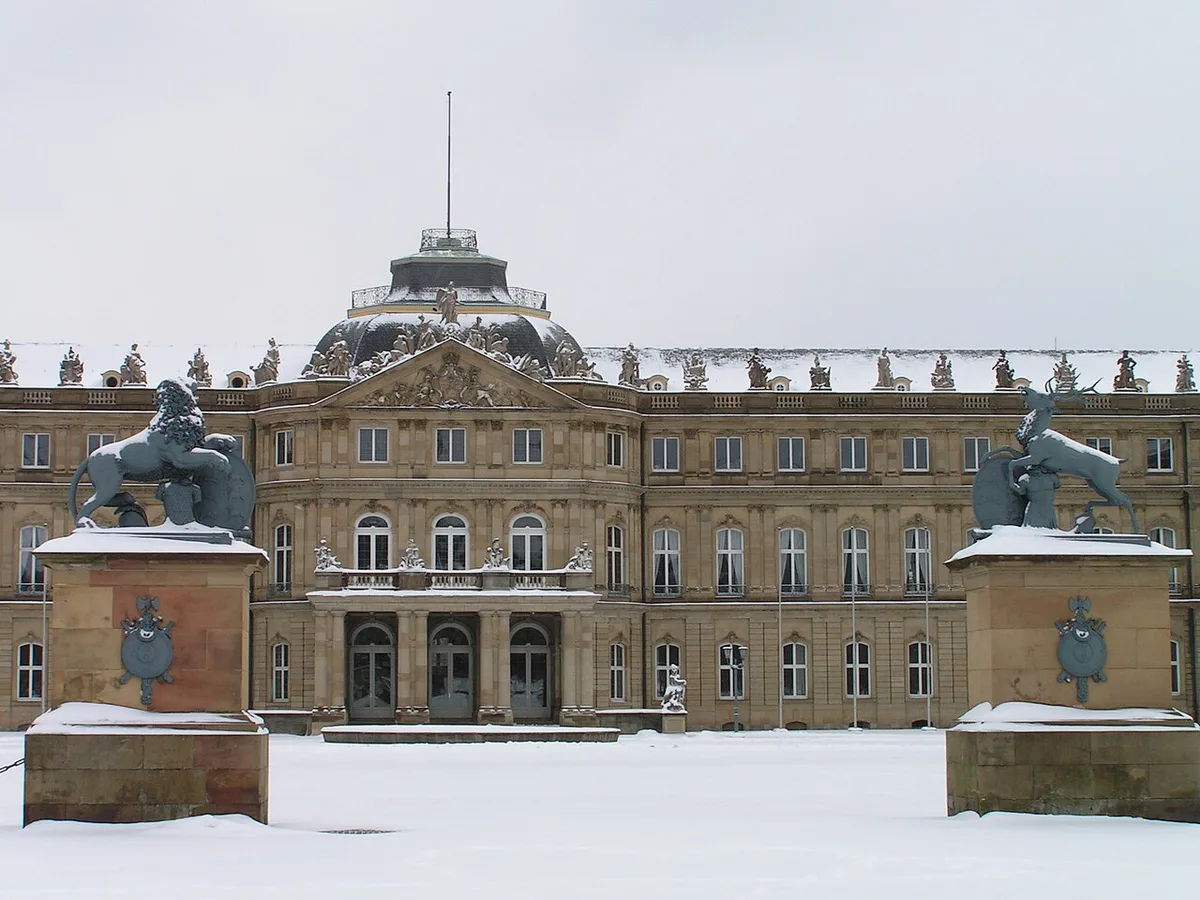
The Market's Four Squares
Four squares make up the market, connected by pedestrian streets in the historic center. Each has its own character rather than repeating the same stalls in a different spot.
- Marktplatz: the market's main square, anchored by the Rathaus (City Hall) and its window-by-window advent calendar, plus a large central tree.
- Schillerplatz: set against the Altes Schloss (Old Palace) and the Stiftskirche, with a heated antique-market tent tucked among the food and craft stalls.
- Schlossplatz: home to the Winterdorf winter-village zone, an outdoor ice rink, rides, and a Children's Fairyland area, all set apart from the main gift alleys.
- Karlsplatz: site of the Finnish Christmas Village (Finnisches Weihnachtsdorf), serving Glögi and flame-grilled salmon (Flammlachs).
History, the Opening Ceremony, and Green Power
Documented records connect the market to Stuttgart's city center as far back as 1692, well before most European Christmas markets kept written schedules. It has grown from a single trade fair into today's four-square footprint over that time. The market also runs on local green electricity rather than a standard grid mix, a detail worth knowing if sustainability factors into travel choices. Opening night follows a set format even though the calendar date shifts. Stuttgart's mayor formally opens the market at 6pm, and a 25-meter Christmas tree near the Altes Schloss is lit as part of the ceremony. Choir and music performances round out the evening, and under the 2026 rule that ceremony falls on Wednesday, 25 November, a derived date rather than an organiser-confirmed one.
Signature Sights: Rooftop Displays and the Advent Calendar
Stuttgart's stalls are known less for their size than for their roofs. Every stall owner decorates their own roofline, and the results range from mechanical reindeer to hand-painted winter scenes. Look up as you move between squares rather than only scanning the counters. Vendors compete informally each year for the best-decorated roof, and it is one of the details that separates this market from a standard row of stalls. The Rathaus doubles as a giant advent calendar through December. Each window represents a different city district and opens on its date, and the lit displays show best after dark. Daily concerts add to the program: close to 60 choirs and music groups perform across the run, many in the Altes Schloss courtyard or on the Stiftskirche steps.
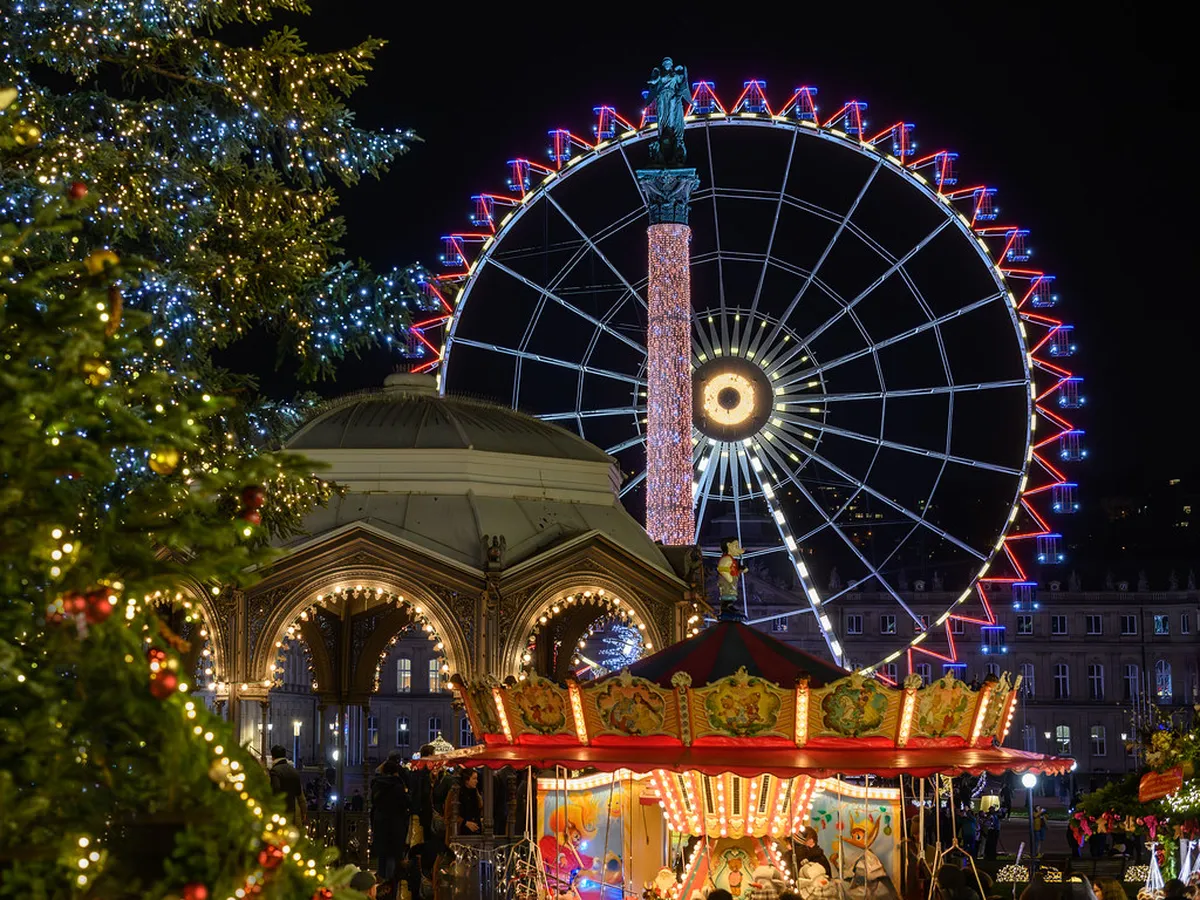
The mayor's 6pm tree-lighting ceremony marks the formal opening, and evening visits afterward reveal both the elaborately decorated stall rooftops vendors compete to perfect and the Rathaus advent calendar windows that light after dark.
What to Eat, Drink, and Buy
Regional Swabian dishes anchor the food stalls alongside standard Christmas market fare.
- Maultaschen - Swabian ravioli, usually filled with meat, spinach, or both
- Kasespatzle - soft egg noodles baked with cheese and topped with fried onions
- Hutzelbrot - a dense fruit bread
- Springerle - anise-flavored biscuits stamped with an embossed design; some stalls also sell the wooden molds used to make them
- Gluhwein - mulled wine, the market's signature drink
- Roasted almonds and Flammkuchen - flatbread with cream, onions, and bacon
The Pfand System and What to Buy
Gluhwein and other hot drinks come in a souvenir mug rather than a disposable cup. Stalls charge a small deposit on the mug, called Pfand, refundable when you return it to the same stall. Keeping the mug as a souvenir is common, and most visitors do exactly that. Beyond food, the stalls sell wooden nutcrackers, hand-carved ornaments, and small craft items typical of German Christmas markets. The heated antique tent at Schillerplatz is worth a separate stop for anyone hunting books, glassware, or older decor rather than new stock.
Stuttgart Christmas Market vs. Stuttgart Weindorf
Stuttgart runs two signature outdoor events in the city center, roughly six months apart. Comparing them helps decide which one fits a given trip.
| Stuttgart Christmas Market | Stuttgart Weindorf | |
|---|---|---|
| Season | Late November to 23 December | About twelve days from late August into early September |
| Signature drink | Gluhwein (mulled wine) | Regional Wurttemberg wine by the glass |
| Atmosphere | Lit stalls across four squares | Open-air wine tasting in the city center |
| Good for | Holiday shopping and family activities | Warm-weather evenings and regional wine tasting |
Comparing the Two Seasons
The market draws crowds for holiday shopping, food, and lights across a winter season that closes 23 December every year. The Stuttgart Weindorf guide covers the summer counterpart, held over about twelve days from late August into early September in the same city center. Both events share some of the same squares, so visitors researching one often end up asking about the other. Check the official Weindorf site for that event's current schedule.
Getting There, Where to Stay, and What to Pack
Reaching the market from the Hauptbahnhof (main train station) means a walk down Konigstrasse, the city's main pedestrian shopping street, which runs roughly 1.2 km toward Schlossplatz. U-Bahn, S-Bahn, and bus lines also stop at Schlossplatz, Charlottenplatz, and Rathaus, with Stadtmitte a short walk further. Driving into the center is possible, but paid parking fills quickly on weekend evenings, so public transit is the more reliable option. Stuttgart's tourism office publishes current transit and event updates through the season. For walkability, look at hotels near the Hauptbahnhof or along Konigstrasse. Both put every square within reach on foot and keep U-Bahn and S-Bahn connections close for the rest of a Stuttgart visit; the Stuttgart city guide covers sights beyond the market itself.
Packing for Cobblestones and Damp Cold
Two factors matter more than a heavy coat. Cobblestones cover most of the market's paths, so sturdy, low-heeled boots with real grip beat fashion boots. Stuttgart's cold is also a damp cold from evening humidity rather than a dry cold, so thermal base layers under a coat work better than one thick layer alone. Gloves that still work a phone screen help for photographing the rooftops without stopping every few minutes to strip a layer off.
When to Visit: Morning Crowds vs. Evening Lights
Morning hours suit anyone prioritizing photos of the decorated stall roofs or wanting to shop without heavy crowds. The market opens at 10am Monday through Saturday and 11am on Sunday, so early openings are the quietest window most days. Evenings bring the fuller atmosphere: lit stalls, concerts, and advent calendar windows show best after dark. Friday and Saturday nights run latest, to 10pm, and are also the most crowded. A weekday evening earlier in the week balances atmosphere against crowd size better than a weekend visit.
Explore christmas market in other cities
Frequently Asked Questions
Is the Stuttgart Christmas market free to enter?
Yes. Walking through all four squares, Marktplatz, Schillerplatz, Schlossplatz, and Karlsplatz, costs nothing. You only pay for food, drinks, and anything you decide to buy. Some add-on activities, like ice rink admission or specific rides, may carry their own separate cost, so budget a little beyond the Gluhwein and snacks.
When does the Stuttgart Christmas market open in 2026?
The market always opens on the Wednesday before the first Sunday of Advent and runs to 23 December. That rule places the 2026 opening on Wednesday, 25 November, a date derived from the pattern rather than one organizers have separately confirmed. Check the official Stuttgart Christmas market site closer to the season for the confirmed schedule.
Can you pay with a credit card at the stalls?
Cash is still the more reliable option at most individual stalls, though card acceptance has grown in recent years. Some vendors take contactless payment; others remain cash-only. Carry euros so a cash-only stall never gets skipped over a payment issue.
Is the Stuttgart Christmas market family-friendly?
Yes. Schlossplatz includes a Children's Fairyland area along with an outdoor ice rink and rides aimed at younger visitors. A live nativity display with real animals adds another stop for families. Strollers can move through the squares, though cobblestones make sturdy footwear worthwhile for kids too.
How much time should you plan for a visit?
Plan at least half a day to walk all four squares at an easy pace. Add more time for concerts, the antique tent at Schillerplatz, or sitting down with Gluhwein between stalls. Visitors combining the market with general sightseeing in the city center often plan a full day.
What is the easiest way to reach the market from the train station?
Walk down Konigstrasse, the pedestrian street running roughly 1.2 km from the Hauptbahnhof toward Schlossplatz. U-Bahn, S-Bahn, and bus lines also stop at Schlossplatz, Charlottenplatz, and Rathaus, with Stadtmitte a short walk beyond those stops.