

Cannstatter Volksfest: The Complete Stuttgart Guide
Last updated July 2026: the Cannstatter Volksfest returns to Stuttgart's Cannstatter Wasen for its 179th edition, and 2026 also marks a rarer Agricultural Main Festival (LWH) year that widens the fairground footprint. If Munich's Oktoberfest tents are already booked or priced out of reach, this guide breaks down whether Stuttgart's own beer festival delivers a comparable experience for less hassle. Expect a practical breakdown of tents, transit from Bad Cannstatt, and where to stay without paying Stuttgart's peak-week hotel rates.
What Is the Cannstatter Volksfest?
Cannstatter Volksfest takes place each year on the Cannstatter Wasen, a fairground in Stuttgart's Bad Cannstatt district near the Neckar River. It began in 1818 as a harvest festival, organized after crop failures linked to the 1815 eruption of Mount Tambora. King Wilhelm I and Queen Katharina created the event to support struggling farmers, and agriculture stayed central to its identity for decades. Locals often shorten the name to simply Wasen. This guide covers the original festival in Stuttgart, not the Philadelphia-based Cannstatter Volksfest-Verein heritage club that shares its name. Wikipedia and the festival's own site describe it as widely considered the second-largest folk festival in the world, behind only Munich's Oktoberfest. Because it draws far fewer international visitors than Munich's event, it's often framed as the more approachable option for a first beer-festival trip to Germany. For the full spread of dates across the country, see our German festival calendar.
Cannstatter Volksfest 2026 Dates: What the Festival's Rule Tells You
Cannstatter Volksfest follows a fixed recurring rule rather than a single locked calendar date. It runs for 17 days, opening on the Friday after the last Saturday in September and continuing into the second weekend of October. That 17-day run stretches across three weekends, ending on the second Sunday in October. Applying that rule to 2026 puts the festival at September 25 through October 11, 2026. Treat that window as derived from the recurrence pattern, not as a final confirmation, and check the official Cannstatter Volksfest website closer to your trip. Opening hours and any early-closing days for individual tents also sit on that same official site, since they can shift year to year.
Cannstatter Volksfest vs. Oktoberfest: Which Should You Choose?
Choosing between the two festivals comes down to crowd tolerance and how much English you want to hear around you. Cannstatter Volksfest skews local: visitors mostly come from the surrounding region, and the atmosphere leans Swabian rather than international. Munich's Oktoberfest draws a heavier international crowd and correspondingly longer lines for popular tents. Getting a table without a reservation is generally more realistic in Stuttgart, especially on weekdays, though weekend afternoons still fill fast in the bigger tents. Music leans toward German-language top-40 cover bands rather than brass ensembles in most large tents at the Wasen, a different texture than the Oompah sound some visitors expect from Munich.
| Factor | Cannstatter Volksfest | Oktoberfest |
|---|---|---|
| Crowd | Mostly regional, Swabian-dialect atmosphere | International, heavier tourist volume |
| Tent entry without a reservation | More realistic on weekdays | Harder, especially in peak tents |
| Beer variety per tent | Multiple styles - Helles, Pils, Kellerbier, Hefeweizen | Mostly one Festbier per tent |
| Lodging cost pressure | Lower, with satellite bases like Ulm available | Higher, driven by peak-week demand |
The Beer Tents: Atmosphere and Reservations
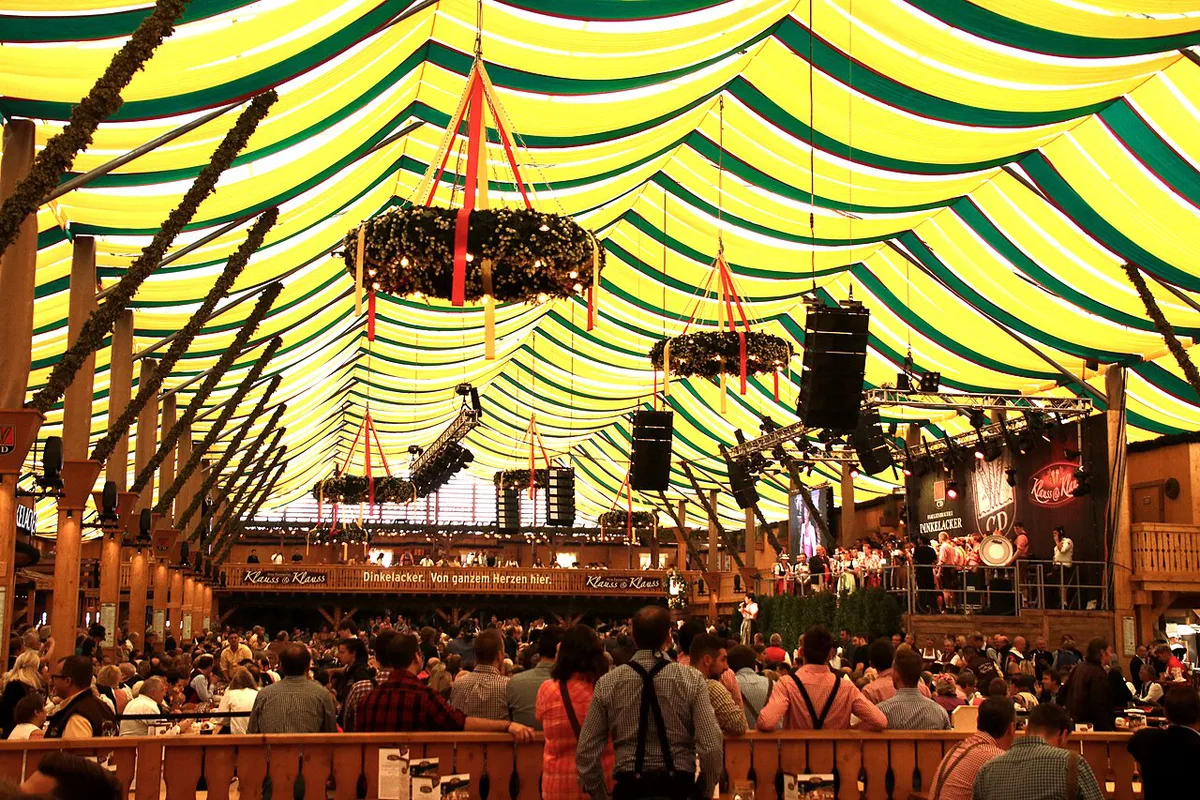
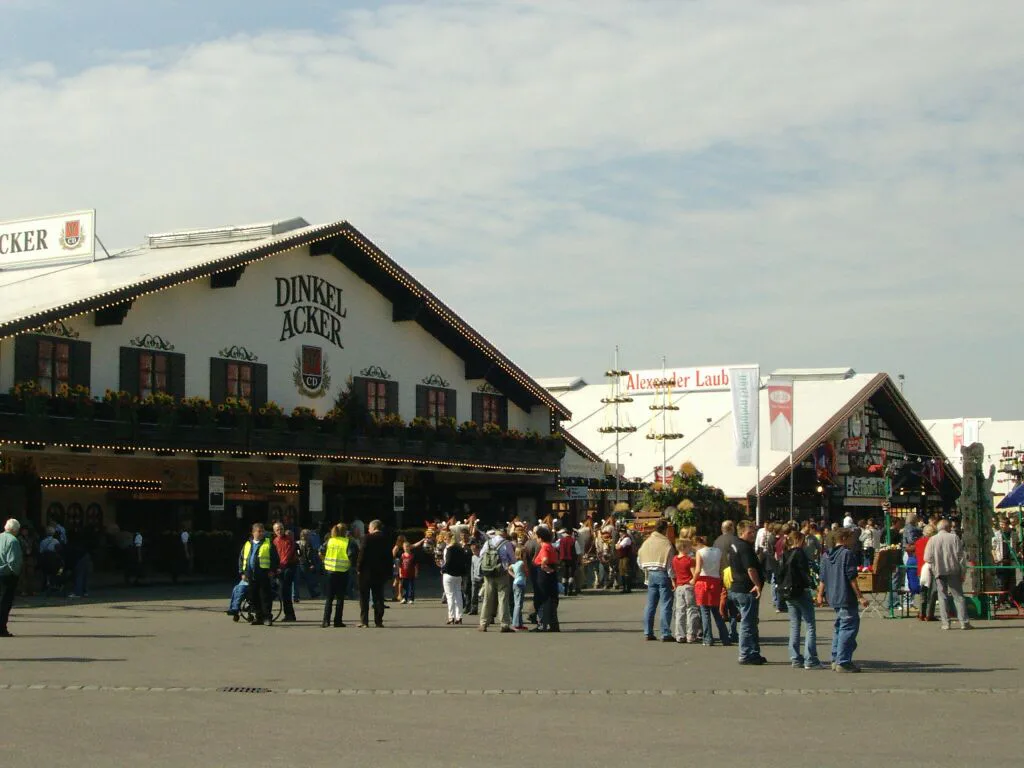
Seven large beer tents anchor the Cannstatter Wasen, each seating between roughly 1,800 and 5,200 guests. Four breweries supply them: Stuttgarter Hofbräu, Schwabenbräu, Dinkelacker, and Fürstenberg. Tents vary in mood as much as beer style, from the chalet-style Schwabenwelt tent to the rustic Almhütte Royal with its mountain-cabin decor. Almhüttendorf leans into that same Alpine theme, with mock rock formations and mounted-deer displays for a lighthearted contrast to the beer-hall benches. General admission covers most daytime hours, but sit-down tables inside the larger tents are commonly reserved in advance through each tent's own booking contact, listed on the official festival site. Albdorf serves a more outdoor, rustic food scene away from the main tent benches, worth a stop between rounds.
- Schwabenwelt - chalet-style facade with live bands
- Wasenwirt
- Göckelesmaier (Stuttgarter Hofbräu) - known for roasted chicken, called Göckele locally
- Dinkelacker tent - yellow-and-gold decor and a table-dancing crowd
- Almhütte Royal / Almhüttendorf - Alpine cabin theme with rustic decor
- Albdorf - outdoor, rustic food area separate from the main tents
Beyond the Beer: The Fruchtsäule, the Parade, and Fairground Traditions
One clear link to the festival's farming origins is the Fruchtsäule, a fruit column that stands 26 meters tall over the fairground. Its base traces back to the first 1818 event, when King Wilhelm I contributed fruit, vegetables, and grain for a harvest display. A parade traditionally runs on the first Sunday, featuring historical uniforms, traditional trade costumes, and horse-drawn brewery wagons. That first parade, held in 1841, drew more than 10,000 participants and an estimated 100,000 spectators. A later parade in 1954 reportedly drew a record 300,000 onlookers. Family days, carnival rides, and a Ferris wheel and roller coaster round out the fairground beyond the tents. Historical accounts credit King Wilhelm I with the era's nickname 'King of the Farmers and Farmer Among Kings' for his role reviving Württemberg's agriculture. For a different kind of costumed procession on the German calendar, Cologne’s carnival runs each winter with its own parade traditions.
Getting There: VVS Transit, S-Bahn, and the Bad Cannstatt Walk
Long-distance and intercity trains stop at Stuttgart's main station, Hauptbahnhof, not at Bad Cannstatt. From Hauptbahnhof, the VVS network's S-Bahn lines S1, S2, and S3 connect to the Bad Cannstatt station, which sits closest to the Wasen fairground. Budget extra walking time between the Bad Cannstatt station and the tent entrances, since the fairground stretches across a wide meadow along the Neckar. Crowd density on the approach paths is the main slowdown on peak weekend afternoons, not the walking distance itself. Building in a buffer before a reserved tent time is worth it once platforms and connecting corridors fill up.
Where to Stay: Stuttgart Hotels and the Ulm Strategy
Stuttgart hotel rates climb during the festival window, and rooms close to the Wasen book out first. Basing in Ulm is a workable alternative: it sits about an hour from Stuttgart by direct train, keeping a same-day round trip realistic. Ulm's old quarter includes Ulm Münster, often cited as the tallest church steeple in Germany, plus a walkable district along the Danube and a handful of local breweries. Train connections back to Stuttgart run frequently enough that a same-day trip doesn't require planning around a single departure. Booking a room in Ulm instead of central Stuttgart during the festival's busiest weekends can meaningfully cut lodging costs, since demand there doesn't spike the same way.
The Agricultural Main Festival (LWH): Why 2026 Is Bigger
Roughly every four years, Cannstatter Volksfest runs alongside the Landwirtschaftliches Hauptfest, the Agricultural Main Festival known as the LWH. According to the festival's own site, 2026 is one of these LWH years, pairing the 179th Cannstatter Volksfest with the agricultural showcase. LWH adds livestock displays, farm machinery exhibits, and other agricultural programming that isn't part of a standard non-LWH year. Because the combined event covers a larger footprint and draws more visitors, expect busier tents and fairground paths throughout the run, even on weekdays. Per that same site, the prior, non-LWH 178th edition alone drew about 4.2 million visitors, so an LWH year is worth planning around with extra lead time.
Costs, Tickets, and Budgeting for the Wasen
Entry to the Cannstatter Wasen fairground itself is free; the cost sits in beer, food, and rides once inside. None of the festival's official channels publish a locked-in Maß price this far ahead of the 2026 run, so check current tent menus on the official Cannstatter Volksfest website closer to your visit. Several tents pour by the half-liter as well as the full-liter Maß, a practical way to sample more than one beer style without committing to a full liter each round. Carnival rides on the fairground are priced separately from the tents, typically per ride, so check on-site signage for current rates. Carry Euros: many German festival tents lean on cash for tabs, so confirm each tent's card policy before you sit down for a round.
Mistakes to Avoid and Local Etiquette
Tracht - dirndls and lederhosen - is common at the Wasen, but it isn't required to get into any tent. Reservation windows for the larger tents tend to open well before the festival starts, so contact tents directly through the official site's tent list as soon as a new season's booking information is posted. Weekday visits, especially early afternoon, are noticeably calmer than weekend sessions, which fill benches and dance floors fast. Other major German festivals follow the same early-demand pattern. Wacken’s metal festival fills its planning windows months ahead each summer. The Nürburgring festival shows the same early-booking pattern each year. During an LWH year like 2026, that weekday-versus-weekend gap in crowd size still applies, but overall attendance runs higher across the board.
Is the Cannstatter Volksfest Worth It?
For a short Stuttgart itinerary, Cannstatter Volksfest earns its place, particularly when paired with a stop at the Mercedes-Benz Museum close to the festival grounds. It delivers the tents-and-fairground experience travelers associate with Oktoberfest, without matching Munich's peak-week crowds and lodging pressure. Extending the trip into the winter market season is straightforward from here. Nuremberg Christkindlesmarkt opens in the weeks before Christmas. Dresden Striezelmarkt runs on a similar seasonal window. Travelers building a longer culture itinerary might plan around the Berlin International Film Festival in February. Kiel Week runs each June for a different kind of regional festival.
Explore more Cannstatter Volksfest guides
For trip-planning details, see Cannstatter Volksfest (official) and Official regional tourism.
Frequently Asked Questions
When is the Cannstatter Volksfest in 2026?
This festival follows a fixed rule of 17 days, opening the Friday after the last Saturday in September and running into the second weekend of October. Applying that rule to 2026 points to September 25 through October 11, 2026. Confirm final dates on the official Cannstatter Volksfest website before locking in travel.
Is the Cannstatter Volksfest cheaper than Oktoberfest?
Lodging pressure is the biggest cost driver at both festivals, and Stuttgart hotel rates rise less sharply than Munich's during Oktoberfest week. Basing in Ulm, about an hour away by train, is a further way to manage costs around the Wasen. Beer and food prices inside the tents themselves are set by each operator, so check current tent menus directly.
Do you need a reservation for the beer tents?
General admission covers most daytime hours without a booking. Sit-down tables in the larger tents are commonly reserved in advance through each tent's own contact info, listed on the official festival site, and reservation windows tend to open well before the festival starts.
What is the Fruchtsäule?
Fruchtsäule is a 26-meter fruit column that has anchored the festival since its first edition in 1818. It nods to the festival's roots as a harvest festival organized under King Wilhelm I.
What makes 2026 an LWH year?
Roughly every four years, the Cannstatter Volksfest runs alongside the Landwirtschaftliches Hauptfest, the Agricultural Main Festival known as the LWH. 2026's edition, the festival's 179th, pairs with the LWH, which adds agricultural exhibits and typically draws larger crowds than a standard year.
How do you get from Stuttgart Hauptbahnhof to the festival?
Long-distance trains stop at Hauptbahnhof, not at Bad Cannstatt. From there, VVS S-Bahn lines S1, S2, and S3 run to the Bad Cannstatt station, which sits closest to the Wasen fairground entrances.