

Cologne Carnival: Navigating the Fifth Season
Last updated July 2026. Cologne Carnival never falls on the same date twice. The street celebration always opens on Weiberfastnacht, the Thursday before Ash Wednesday, and Ash Wednesday itself shifts every year with Easter. That single rule separates Cologne Carnival from Germany's fixed-date festivals and shapes every booking decision in this guide, from Sitzung tickets to Altstadt hotel timing.
Cologne Carnival Dates: A Two-Stage Start You Can't Pin to the Calendar
Cologne Carnival actually begins twice each year. The 2026/27 session opens on 11 November 2026 at 11:11 a.m., a fixed date that never moves. Festkomitee Kölner Karneval, the organizing committee running the season since 1823, kicks off months of Sitzungen (carnival sessions) across the city at that moment. Street carnival itself is the six days many visitors mean when they say Cologne Carnival. It only starts on Weiberfastnacht, the Thursday directly before Ash Wednesday, and runs through Karnevalsdienstag, also called Veilchendienstag or Violet Tuesday. Because Ash Wednesday is set by the Christian liturgical calendar and moves with Easter, Weiberfastnacht can land anywhere from late January to early March depending on the year. There is no derivable fixed date to publish here. Check the Festkomitee Kölner Karneval's official calendar for confirmed dates before booking any specific season.
- Weiberfastnacht (Fat Thursday) - street carnival opens at Alter Markt
- Karnevalsfreitag (Carnival Friday)
- Karnevalssamstag (Carnival Saturday)
- Karnevalssonntag / Tulpensonntag (Carnival Sunday)
- Rosenmontag (Rose Monday) - the main parade
- Veilchendienstag (Violet Tuesday) - Nubbel burning
- Aschermittwoch (Ash Wednesday) - fish dinner, carnival ends
The Crazy Days, Day by Day: What Actually Happens
Each of the six days carries its own rituals, and missing the sequence means missing most of the atmosphere.
- Weiberfastnacht: Women take charge, snipping men's ties as a symbol of the old order flipping. Alter Markt's stage show starts at 11:11 a.m., and its square fills by around 9 a.m. Arrive by roughly 8:30 a.m. if you don't already hold a ticket, or you likely won't get inside the cordoned area.
- Carnival Friday: The Star March draws costumed groups from every neighborhood into the city center. Most of the season's Sitzungen (session shows) run this same evening.
- Carnival Saturday: The Geisterzug (Ghost Parade) sets off in the evening. It needs no registration and welcomes spontaneous joiners. Its route changes with each year's theme. This modern parade dates to 1991, though the tradition behind it goes back to 1860.
- Carnival Sunday (Tulpensonntag): The Schull- un Veedelszoch, Cologne's school-and-neighborhood parade, is often considered more personal than Rosenmontag because every costume and float is handmade by local schools and clubs.
- Rosenmontag: The climax caps the week. Its parade runs roughly 5 miles from Chlodwigplatz in Südstadt through the city center. Crowds catch around 300,000 Strüssjer, or flowers, along the route. Cologne's tourist office also counts about 330 tons of candy thrown across the whole season.
- Veilchendienstag: Neighborhood parades fill Nippes, Ehrenfeld, and Mülheim, drawing up to 200,000 spectators. At midnight, the Nubbelverbrennung burns a straw effigy outside pubs across the city, absolving the season's excesses.
- Aschermittwoch: A traditional fish dinner marks the close of the Fifth Season as Lent begins.
Essential Cologne Carnival Traditions and Etiquette
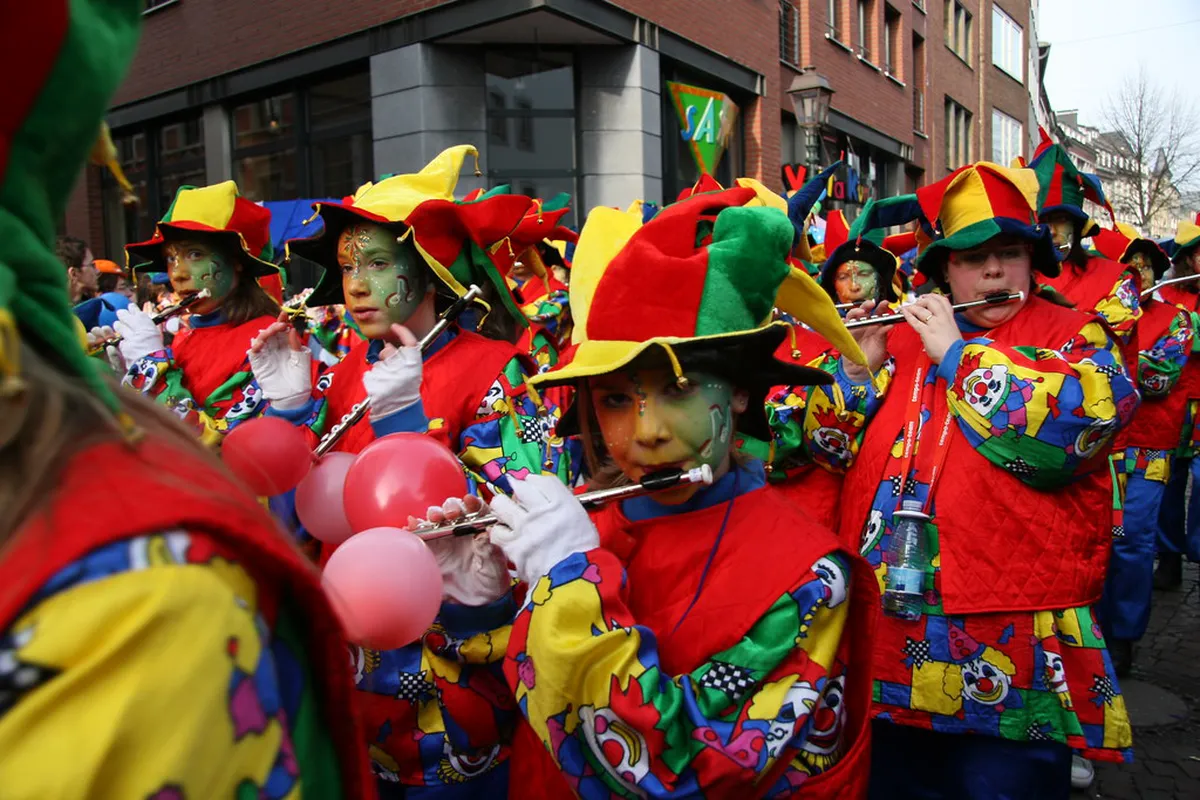
Three costumed figures lead the entire season: the Prince, the Peasant, and the Maiden, together called the Dreigestirn. Local tradition casts the Maiden as a man in women's dress. Nazi authorities broke that custom only from 1936 to 1943, ordering an actual woman into the role instead. The Maiden's Roman-style gown nods to Agrippina the Younger, the Roman empress born in Cologne who had the city renamed Colonia Claudia Ara Agrippinensium. His formal title, Seine Tollität, or His Madness, comes with leading the final float in the Rosenmontag parade. Seine Deftigkeit, or His Heftyness, is the Peasant's title, and he carries a sword and keys referencing the city's medieval independence. Shout Kölle Alaaf, and nothing else. Helau is the cheer next door in Düsseldorf and in Mainz, and using it in Cologne marks you instantly as an outsider. Expect a Bützchen, a quick peck on the cheek, from strangers throughout the week. Locals treat it as carnival tradition, not flirtation, and only spoilsports turn one down. Kölsch etiquette runs on trust. Bars keep bringing full glasses without being asked. Set a coaster on top of your glass when you've had enough, or the beer keeps coming.
Getting There and Where to Stay for Cologne Carnival
Driving into central Cologne during carnival week isn't realistic. Rolling road closures shut down the parade routes and surrounding streets. KVB, Cologne's public transit operator, becomes the only practical way to move around, though services get crowded and occasionally rerouted near parade times. Where you sleep changes the trip. Altstadt hotels put you inside the Alter Markt and Heumarkt crush, footsteps from the loudest Sitzungen and the earliest lines. Südstadt, Ehrenfeld, and Nippes sit outside the main tourist crowd and host their own Veedelszüge, a calmer way to experience the same week. Street carnival costs nothing to attend. Sitzungen and the ticketed Alter Markt stage show are a different story. Seats routinely sell out months ahead. Check current pricing and availability directly through the Festkomitee Kölner Karneval or individual venue box offices well before the season starts.
The Veedel vs. the Altstadt: Where Locals Actually Celebrate
Alter Markt and Heumarkt deliver the postcard version of Cologne Carnival: dense crowds, amplified Sitzung stages, and a wall of costumes packed shoulder to shoulder. That intensity is real, but it isn't the only version of the week. Veedelszüge, the neighborhood parades in districts like Südstadt and Ehrenfeld, run on a smaller scale, with local bands, homemade floats, and a crowd that knows the songs. Locals often treat these as the more genuine carnival, away from the Old Town's ticket lines and stage barricades. Cologne's Tourist Board counts more than 480 registered Carnival associations across the city, a scale that explains why celebrations spill well beyond the Altstadt. Zülpicher Strasse, near the university, has a reputation locals actively avoid. Heavy drinking dominates the strip more than carnival tradition does. Severinstrasse offers a calmer version of the same street-carnival energy nearby. The Nubbel tradition gets less attention from casual visitors, but it's the emotional close of the season for locals. Straw effigies burn at midnight going into Ash Wednesday outside pubs across the city. Notable Nubbel-burning ceremonies happen at:
- St. Agnes Church
- Nippes
- Südstadt
- Kwartier Latäng, the student district
- the Altstadt
Jeck Survival Checklist: What to Wear and What to Skip
Costume choices separate visible outsiders from actual Jecks, or carnival revelers. A few practical rules cover most of what matters.
- Skip the store-bought basic costume. Homemade or clearly personalized outfits read as effort, and Cologne Carnival crowds notice the difference.
- Wear a hat at minimum. Locals treat a hat as the lowest acceptable bar for carnival dress, even over a full costume.
- Build in layers. Late-winter Rhineland temperatures during carnival season often hover near freezing, in the mid-30s Fahrenheit. Layers work better than one heavy coat for a week spent moving between outdoor parades and indoor Sitzungen.
- Design for the bathroom. A costume that's easy to get in and out of matters more once the Kölsch starts flowing.
- Carry a coaster habit. Placing a coaster on top of your glass is the only way to stop a Brauhaus server from refilling it automatically.
Cologne Carnival vs. Other German Carnivals
Cologne isn't the only city with a movable carnival season, and the differences show up fast once you compare notes. Dusseldorf Karneval and Mainzer Fastnacht run the same Altweiber-to-Karnevalsdienstag window as Cologne, moving with Ash Wednesday every year. Both cities shout Helau instead of Kölle Alaaf. Rottweiler Fasnet, in Rottweil, follows an entirely different regional calendar. Its Narrensprung processions run on Rosenmontag and Fasnetsdienstag mornings, and its season opens 6 January rather than 11 November. For a fixed-date contrast, Oktoberfest’s fixed calendar opens in Munich on the Saturday after 15 September every year. That's why it's easier to book a year ahead for Oktoberfest than for any Rhineland carnival.
| Event | City | Cheer / Signature |
|---|---|---|
| Cologne Carnival | Cologne | Kölle Alaaf; Rosenmontag parade from Chlodwigplatz |
| Dusseldorf Karneval | Dusseldorf | Helau; Rosenmontagszug on Shrove Monday |
| Mainzer Fastnacht | Mainz | Helau; Rosenmontagszug as the season centerpiece |
Where Cologne Carnival Fits in Germany's Festival Calendar

Cologne Carnival's movable dates are the exception, not the rule, across Germany's major festivals. The full year of options lives on the German festival calendar, but the pattern is worth knowing before you plan around any single event.
- Nuremberg's Christkindlesmarkt opens the Friday before the first Advent Sunday every year, a fixed rule with no movable window.
- Dresden's Striezelmarkt follows a similar fixed rule, opening the Wednesday before the first Advent Sunday.
- Stuttgart's Cannstatter Volksfest runs 17 days starting the Friday after the last Saturday in September.
- Kiel Week fills nine fixed days in the last full week of June.
- The Berlin International Film Festival announces 11 days in February, with dates published roughly a year ahead.
- Wacken’s metal festival announces three days in late July or early August each year, without a fixed formula.
- The Nürburgring festival announces three days in early June at the Nürburgring, following that same pattern rather than a fixed rule.
- Cologne Carnival's own window is confirmed only once the Festkomitee Kölner Karneval sets the coming season's calendar.
Explore more Cologne guides
For trip-planning details, see Cologne Carnival (official) and Official regional tourism.
Frequently Asked Questions
When is Cologne Carnival?
Cologne Carnival's street celebration always runs from Weiberfastnacht, the Thursday before Ash Wednesday, through Karnevalsdienstag, or Violet Tuesday. Because Ash Wednesday moves with Easter every year, the exact week shifts annually, sometimes landing in late January and sometimes in early March. Check the Festkomitee Kölner Karneval's official calendar for confirmed dates before booking any specific season.
Do you shout Alaaf or Helau in Cologne?
Kölle Alaaf, always. Helau belongs to Düsseldorf and Mainz, not Cologne.
What is the Nubbel and why does Cologne burn it?
The Nubbel is a straw effigy hung outside pubs during carnival season. It's burned at midnight going into Ash Wednesday, symbolically taking the blame for the week's excesses so the season closes with a clean slate.
Do you need a costume for Cologne Carnival?
A costume isn't required, but locals treat a hat as the bare minimum. Homemade or personalized outfits fit the spirit better than a basic store-bought costume. Something easy to move and use the bathroom in works best across a long day.
Is Cologne Carnival free to attend?
Street carnival costs nothing. Sitzungen and the ticketed Alter Markt stage show are different, often selling out months ahead. Check pricing and availability directly through the Festkomitee Kölner Karneval well before the season starts.
Is there an alternative to the official Rosenmontag parade?
Yes, the Geisterzug, or Ghost Parade, runs on Carnival Saturday evening as a political, do-it-yourself alternative. It needs no registration and welcomes spontaneous participants, and its route changes with each year's theme.